

432 Frequency Sound Playbook: 6 Science-Informed Steps to Support Relaxation, Improve Sleep, and Enhance Emotional Balance
Start With Why: Make Every Minute Count
Set a clear intention before you press play, because a simple, structured plan can turn 432 frequency sound from an interesting idea into a measurable wellness upgrade. If you have been curious whether a 432 Hz (Hertz) tone could ease that nagging shoulder, calm your stress, or help you fall asleep faster, you are not alone. One in three adults reports poor sleep, and roughly one in five lives with chronic pain, according to widely cited public health data. A repeatable checklist removes the guesswork so you can track what actually works for you, avoid common pitfalls, and stop wasting time on random playlists. And yes, you can layer sound with non-invasive tools to amplify your results.
Decide now to run a personal experiment, not a vague vibe session. Commit to a simple baseline, like a 0 to 10 discomfort/tension score and three sleep markers: time to fall asleep, total sleep time, and how refreshed you feel on waking. Then test a conservative, consistent 14-day routine and adjust. For extra precision, Anywhere Healing wearables bring a powerful edge: advanced biosensors read your body’s signals and deliver adaptive frequency support aimed at stress relief, deeper sleep support, and emotional balance. When natural cellular frequencies become disrupted, it can result in pain, stress, poor sleep, and other health imbalances; this playbook helps you explore whether targeted 432 frequency sound plus smart wearables nudge you back toward balance.
Pre-Work Checklist: Set the Stage for Wins
- Define your primary outcome. Pick one: reduce tension, improve sleep quality, or lower stress. Write it down with a target you can measure in two weeks.
- Choose your sound source. Use a reputable tone generator set to 432 Hz (Hertz), a playlist verified as tuned to 432 Hz (Hertz), or retuned instruments. Avoid low-quality rips that add noise.
- Verify tuning before you begin. Spot-check with a tuner app or a spectrum analyzer to confirm the reference pitch is 432 Hz (Hertz), not 440 Hz (Hertz).
- Prepare your listening environment. Dim lights at night, silence notifications, and use comfortable seating or lying posture so your breathing stays easy and unforced.
- Set safe volume. Keep it at a level where you can hear details while still holding a relaxed conversation. If you are using headphones, avoid high volumes and frequent long sessions.
- Record your baseline. Note a 0 to 10 discomfort/tension score; collect three nights of sleep data if available; write your average mood and stress on a 1 to 5 scale.
- Prime your body. Hydrate, take three slow nasal breaths, and decide your session length before you start. Consistency beats intensity.
- Consider pairing with Anywhere Healing wearables. Their advanced biosensors read your body’s signals and coordinate targeted frequencies through Frequana, Alpha Wearable, or Charisma Ring to support stress relief, deeper sleep, and emotional balance.
Watch This Helpful Video
To help you better understand 432 frequency sound, we've included this informative video from DJ Grossman. It provides valuable insights and visual demonstrations that complement the written content.
Use this quick comparison to orient your ear and expectations.
| Reference | What You Hear | Common Use | Notes |
|---|---|---|---|
| 432 Hz (Hertz) | Slightly warmer, subjectively softer | Meditation, relaxation, sleep wind-down | Some listeners report calmer breathing and less tension |
| 440 Hz (Hertz) | Standard concert pitch, bright | Most modern music | Great for performance; not the focus of this protocol |
Match the wearable to your goal and lifestyle so you are not forcing a routine that does not fit you.
| Anywhere Healing Device | Best For | How to Wear | Standout Support |
|---|---|---|---|
| Frequana | Daily balance and gentle stress relief | Wear on the wrist during day sessions or while relaxing | Supports daily balance, energy, and gentle stress relief |
| Alpha Wearable | Sleep wind-down and focused recovery | Wear in the evening or during nap recovery blocks | Designed to support sleep wind-down and focused recovery |
| Charisma Ring | On-the-go calm and discrete use | Wear throughout the day, especially in stressful windows | Supports emotional stability, confidence, and on-the-go energy |
Note: This content is for educational purposes and is not medical advice. If you have a diagnosed condition, are pregnant, have an implanted device, or are prone to seizures, consult your clinician before beginning any sound or wearable routine. Never listen while driving or operating machinery.
Execution Checklist: Deliver 432 Frequency Sound With Precision
- Calibrate your source. Use a tone generator or verified track at 432 Hz (Hertz). For music, choose steady, low-drum or ambient textures to minimize sudden peaks that can pull you out of a relaxed state.
- Choose your delivery method. For sleep, use speakers at low volume so you can put headphones away; for pain relief or focus, closed-back headphones at moderate volume can help you tune in.
- Time your sessions. Try 10 to 15 minutes in the morning for grounding, 10 minutes mid-afternoon for stress relief, and 20 to 30 minutes in the evening for sleep wind-down.
- Stack gentle breathwork. Inhale for 4 counts, exhale for 6 counts, and pause for 2 counts. Slower exhales cue the nervous system toward relaxation.
- Layer Anywhere Healing wearables. Start the relevant program on your chosen device: calming support before bed, recovery support after workouts, or balance support during stressful work blocks. Let the biosensors read your body’s signals while you listen.
- Stay still, but not rigid. Keep your jaw loose, shoulders heavy, and eyes soft or closed. Allow any thoughts to come and go without chasing them.
- Close with a cue. End every session by taking one deliberate stretch and writing a single sentence about what you felt. Small notes make trend spotting easy.
For easy planning, pick a goal and run this starter template for a week.
| Goal | Session Timing | Length | Add-Ons | Notes |
|---|---|---|---|---|
| Tension & Comfort | Late afternoon or post-workout | 15 to 25 minutes at steady 432 Hz (Hertz) | Alpha Wearable or Frequana recovery support | Track 0 to 10 discomfort/tension score before and after |
| Sleep Wind-Down | 60 minutes before bed | 20 to 30 minutes, dim lights | Alpha Wearable sleep program plus nasal breathing | Aim to finish screens at least 30 minutes before bed |
| Calm and Focus | Midday slump window | 10 to 15 minutes | Charisma Ring for on-the-go calm | Stand, stretch, then return to a single task |
Case story for context: Maya, a graphic designer with tight shoulders and restless sleep, ran a 14-day test. She used a simple 432 Hz (Hertz) tone for 20 minutes at 9:30 p.m., paired with Alpha Wearable’s evening support. She logged a nightly 0 to 10 discomfort/tension score and three sleep markers. By day five, she noticed less shoulder guarding and took less time to fall asleep. By day fourteen, her average discomfort/tension score dropped from 6 to 3 and she added about 25 minutes of total sleep time, aligning with common observations that routine plus calm-breathing compounds results. Your numbers will vary, which is exactly why you will validate your own outcomes next.
Validation Checklist: Prove It Works for You
- Track a simple daily scorecard. Before your evening session, record a 0 to 10 discomfort/tension score and your current stress level on a 1 to 5 scale. Each morning, note time to fall asleep, total sleep time, and how refreshed you feel.
- Add one physiology marker if available. If you have a wearable tracker, log your heart rate variability (heart rate variability) and resting heart rate. Many users associate steady heart rate variability (heart rate variability) trends and lower resting heart rate with recovery.
- Use weekly averages. Day-to-day swings are noisy; weekly averages reveal the trend. Compare your baseline week with weeks one and two of your protocol.
- Mark dosage and context. Write session length, delivery method, and whether you layered an Anywhere Healing wearable. Context explains outliers.
- Adjust one variable at a time. Increase or decrease session length by five minutes, or shift the session time, but do not change multiple elements at once.
Steal this table to organize your first two weeks.
| Metric | Tool | Baseline (3 Days) | Week 1 Average | Week 2 Average | Target Shift |
|---|---|---|---|---|---|
| Discomfort/Tension (0 to 10) | Notebook or app | — | — | — | Down 20 to 30 percent |
| Time to Fall Asleep (minutes) | Sleep tracker or log | — | — | — | Down 10 to 20 minutes |
| Total Sleep Time (hours) | Sleep tracker or log | — | — | — | Up 15 to 30 minutes |
| Heart Rate Variability (heart rate variability) | Wearable with heart rate variability (heart rate variability) | — | — | — | Up modestly over two weeks |
| Morning Refresh Score (1 to 5) | Notebook | — | — | — | Up by 1 point |
Make decisions using your data, not wishful thinking. If your discomfort/tension score drops and your sleep improves, keep the routine steady for another two weeks. If results stall, adjust one variable: session timing, volume, delivery method (speakers versus headphones), or wearable pairing. Many people find that a consistent 20 to 30 minutes of 432 Hz (Hertz) in the evening plus an Anywhere Healing wearable strengthens the relax response, which supports stress relief and better sleep. If nights are chaotic, try shifting a portion of listening to late afternoon to pre-empt the stress climb.
Common Misses: Avoid These Roadblocks
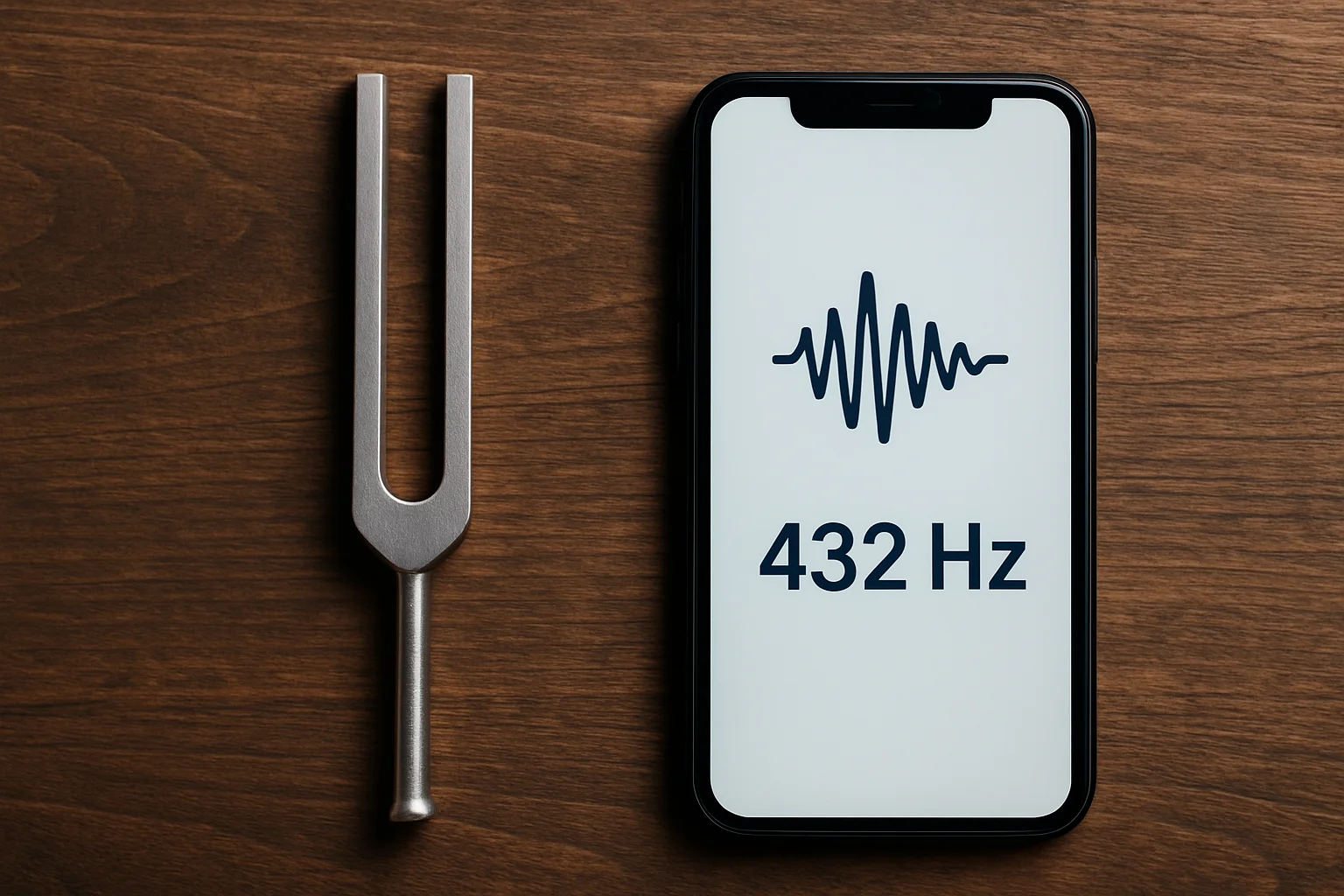
- Skipping verification. Do not assume a track is tuned; spot-check for 432 Hz (Hertz) to avoid placebo-level uncertainty.
- Cranking the volume. Louder is not better. Keep it comfortable and sustainable, particularly with headphones.
- Inconsistent timing. The body loves rhythm. Anchor your sessions at the same times to help your nervous system anticipate calm.
- Chaotic playlists. Frequent tempo or volume swings disrupt relaxation. Choose steady 432 Hz (Hertz) tones or smooth ambient music.
- Expecting one session to fix everything. Aim for compounding benefits with daily practice across two to four weeks.
- Ignoring sleep hygiene. Blue light, late meals, and caffeine sabotage gains. Pair your 432 frequency sound with lights-down and screens-off habits.
- Not stacking with movement and hydration. A five-minute walk and a glass of water before listening can shift physiology toward calm.
- Underusing wearables. Anywhere Healing’s biosensors and adaptive frequency support for stress relief, deeper sleep support, and emotional balance complement sound; do not treat them as either-or.
- One-size-fits-all device placement. Adjust where and when you wear Frequana, Alpha Wearable, or Charisma Ring until your metrics start to move in the right direction.
- Changing too many variables. Tweak one knob at a time so you can attribute cause and effect.
Quick troubleshooting tips:
- If you get sleepy in the afternoon, shorten midday listening to 5 to 8 minutes and keep the evening session longer.
- If you feel wired at night, drop volume, switch to pure tone instead of music, and extend exhale-focused breathing.
- If tension shifts but sleep does not, move one session earlier and add gentle mobility before listening.
- If you do not notice change by day seven, pair with an Anywhere Healing wearable during your highest-stress block and recheck your notebook data.
Conclusion
This simple playbook helps you use 432 frequency sound with intention, turning a calming tone into trackable gains in comfort, sleep quality, and day-to-day emotional balance. Imagine the next 12 months with a routine that is as easy as pressing play and slipping on a lightweight wearable while your body quietly does the repair work it was built to do. What shifts first for you when calm becomes your default setting and you finally have data that proves it?
Elevate Your 432 Frequency Routine with Anywhere Healing
Tap adaptive frequency support to help with stress relief, deeper sleep support, and emotional balance as Anywhere Healing’s wearables read biosignals to personalize sessions as a non-drug option.
Explore Wearables


