

Inside the Tech: How Does Wearable Frequency Therapy Work to Reduce Pain, Improve Sleep, and Restore Balance?
At 3 a.m., you’re staring at the ceiling with a tight neck and a mind that will not shut up. The room is quiet. Your alarm is not. You’ve already flipped the pillow, stretched once, checked the time twice, and done that little internal negotiation we all do: if I fall asleep right now, I can still get almost four hours.
And maybe, somewhere in that scene, there’s a tiny wearable on your skin promising relief by morning. So when you ask how does wearable frequency therapy work, you’re not asking a trivia question. You’re trying to figure out whether a patch, disc, band, or ring is a smart wellness tool, a hopeful placebo, or a mix of both.
I’ve spent enough time around recovery gadgets, sleep tools, and pain-relief claims to know this much: the plain-English version matters. So let’s separate the pitch from the proposed mechanism, and the mechanism from the proof.
What is wearable frequency therapy?
What people mean by “frequency therapy”
Watch This Helpful Video
To help you better understand how does wearable frequency therapy work, we've included this informative video from TEDx Talks. It provides valuable insights and visual demonstrations that complement the written content.
In plain language, wearable frequency therapy is a category of wellness tools that claim to use frequencies, vibrations, or other programmed signals to influence how your body feels and functions. That’s the umbrella idea. The wording shifts from brand to brand, but the promise usually sounds familiar: less pain, calmer stress, deeper sleep, better balance.
That broad framing shows up in current search results. One summary describes “quantum frequency healing” as using energy vibrations to help balance the body and mind. One top-ranking device round-up frames wearable frequency therapy devices as a gentle, non-invasive way to support pain relief, ease stress, and support deeper sleep. Same general story. Different packaging.
Not every product that says “frequency” means the same thing—ask what the device emits, how it’s supposed to work, and what evidence is offered.
What a wearable version looks like
The wearable part is pretty literal. These devices are designed to sit on or near the body rather than stay in a clinic or live on a tabletop. In practice, that can mean a small adhesive disc, a patch, a band, or a ring. You put it on. You wear it through work, rest, or sleep. The appeal is obvious: no needles, no big routine, no pill organizer on the kitchen counter.
Some companies describe their devices as small circular wearables used in frequency-based wellness programs to support the body’s natural rhythms. That tells you two useful things right away. First, this is a skin-worn category. Second, the language of “frequencies” is central to how these products describe themselves.
What it is not (and why that matters)
It is not one standardized treatment with one shared mechanism. That’s where people get tripped up. A wearable sold as “frequency therapy” is not automatically the same as another wearable using the same word on the box. One may talk about stored frequencies. Another may talk about biosignals. Another may lean on sound, light, or electric fields.
It’s also not the same thing as proof. A clean product page and a scientific-sounding phrase can make a device feel more settled than the evidence really is. If you’ve ever looked at a wellness gadget at 11:30 p.m. while half-asleep and thought, this sounds convincing, you’re in very normal company.
Why does wearable frequency therapy matter for pain, sleep, and stress?
How stress spills into sleep and pain
Because these problems travel together. Harvard Health, in a piece by Robert H. Shmerling, MD, points out that stress can affect sleep, mood, and appetite. That tracks with real life. You get stressed, your shoulders climb toward your ears, your sleep gets lighter, and suddenly the sore neck that started as annoying turns into a whole-body issue by Friday.
Harvard Health also notes that the long-term effects of chronic stress have been linked to cardiovascular disease, obesity, and Alzheimer’s disease. That doesn’t mean every rough week becomes a medical crisis. It does mean stress isn’t “just in your head.” It shows up in the body, and it often drags pain and sleep down with it.
Stress is not just a feeling; it can show up in sleep, appetite, mood, and long-term health risk.
Why people want non-drug options
A lot of people don’t want another pill if they can avoid it. Some already take medication and don’t want one more thing. Some want a daytime option they can wear at a desk, on a flight, or while chasing kids through Target. Some are simply tired of feeling “off” without a clear fix.
That helps explain why top-ranking round-ups say more people are turning to wearable frequency therapy devices for pain relief, stress reduction, and better sleep. The category is convenient, low-friction, and easy to imagine fitting into daily life. Put it on, get through the day, support better sleep tonight — that’s a very compelling storyline.
Why “balance” is such a powerful promise
“Restore balance” is one of those phrases that lands because it matches how bad weeks feel. Not always sick. Not exactly injured. Just off. Your sleep is choppy, your jaw is tight, your patience is thin, and your back feels like you moved furniture when all you did was answer emails.
The catch is that “balance” can also hide vagueness. It sounds soothing, but it doesn’t tell you what changed, how much it changed, or whether anyone measured it. So yes, the promise is powerful. You just don’t want it to stay fuzzy.
How does wearable frequency therapy work?
The claimed signal pathway
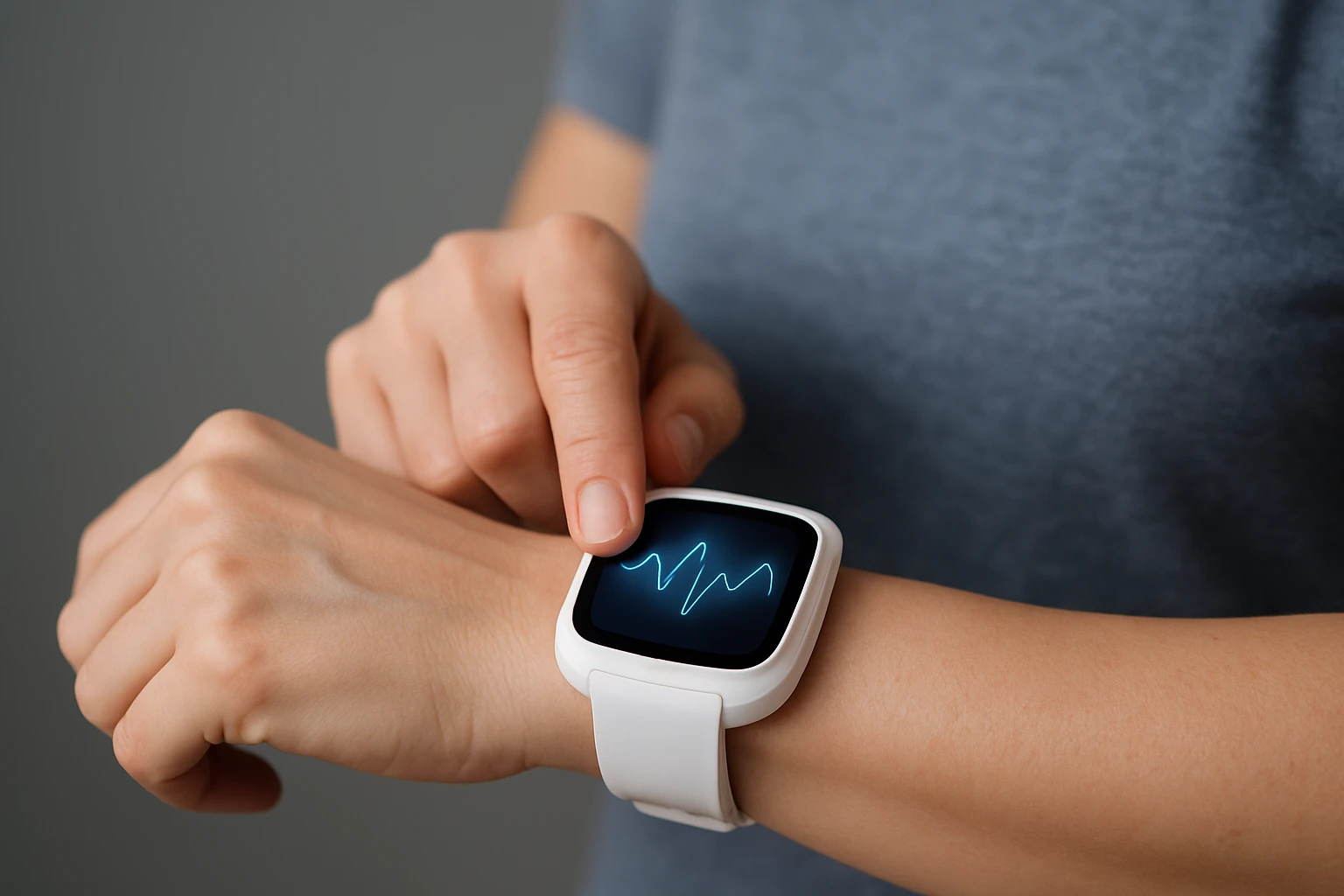
The proposed mechanism usually goes like this: the device carries or emits a programmed signal, that signal interacts with the body through skin contact or close wear, and the body responds in a way that may support calmer stress, less pain, or steadier sleep. That’s the short version.
Different sources describe the “signal” differently. Other companies talk about stored frequencies, electromagnetic patterns, or biosignals. That variety matters. If the claimed mechanism changes from one device to the next, you should judge them one by one — not as if they all belong in the same evidence bucket.
The real question is not whether a device sounds scientific—it’s whether the specific mechanism has credible evidence behind it.
How the wearable is applied
Most versions are meant to be worn directly on the skin or very close to it. Some companies say their devices are infused and programmed with specific frequencies and applied directly to the skin with skin-friendly adhesive tape. Notice the precision there: the tape is described as approved for skin wear, not the whole treatment concept.
That placement piece matters more than people think. A collarbone placement, an upper arm placement, or a forearm placement may each come with a different explanation from the brand. If instructions are vague — “just wear it somewhere” — that’s a sign to slow down and ask harder questions.
Why some brands talk about “normalizing” the body
When brands use words like “normalize,” “rebalance,” or “restore harmony,” they’re usually saying the body has drifted into a less efficient pattern and the device is meant to nudge it toward a steadier state. Think less noise, more order. Less overreaction, more regulation. That’s the idea they want you to picture.
Some summaries say the approach is intended to help reduce stress, relieve pain, and clear the mind by balancing the body’s natural rhythms. That’s a readable explanation. It still leaves open a harder question: which rhythms, measured how, and with what results in real people? That’s where marketing language stops and evidence has to start.
What evidence is there that it actually helps?
What the current top results actually claim
If you scan the current search results, you’ll notice a split. One side explains the concept in broad, optimistic language. The other side, like Harvard Health, talks about the real impact of stress on health without endorsing wearable frequency therapy itself.
Some frequency-healing summaries say the approach is still being studied. A top-ranking article from Anywhere Healing describes wearable frequency therapy as a natural-healing approach, but it does so in a promotional, explanatory format rather than a clinical review. That doesn’t make it useless. It just tells you what kind of source you’re reading.
What’s missing from the summaries
What you don’t get from most high-visibility summaries is the stuff that actually helps you judge a health claim: clear trial design, how outcomes were measured, how long benefits lasted, who didn’t respond, and what happened compared with a control group. Those gaps matter. A lot.
You also don’t get much detail on failure. That’s a red flag in wellness tech. Real tools help some people, not everyone. Real studies show mixed outcomes. Real clinicians talk about limits. If every page sounds like a smooth glide from “discomfort” to “balance,” you’re reading a sales environment, not a settled science file.
How to separate hope from proof
When I’m evaluating a device like this, I sort claims into three buckets: what the source describes, what the source suggests, and what the source proves. That one habit can save you money and disappointment.
| Source | What It Helps You Understand | What It Does Not Prove |
|---|---|---|
| Harvard Health | Stress affects sleep, mood, appetite, and long-term health | That wearable frequency therapy works for those problems |
| Frequency-healing summary | How frequency healing is commonly described, and that it is still being studied | That a specific wearable delivers clinical benefit |
| Top-ranking device round-up | How the category is marketed for pain, stress, and sleep | That outcomes are guaranteed or broadly proven |
| Product page | Device form, skin application, adhesive details, and company explanation | That all frequency wearables work the same way for everyone |
If a page promises to solve pain, sleep, and balance all at once, treat that as a claim to verify—not a guarantee.
What are the most common questions before trying it?
Is it safe to wear every day?
These products are typically presented as non-invasive, skin-worn wellness tools. That lowers the barrier for a lot of people. Still, “non-invasive” does not mean “never annoying” or “right for everybody.” Adhesives can irritate skin. Wear time matters. Placement matters. Instructions matter.
If you have ongoing pain, a diagnosed sleep disorder, or other health concerns already in the mix, it’s smart to ask a clinician before turning a wellness gadget into your main plan. That’s not fear talking. That’s just good sequencing.
How long before someone notices a change?
That depends on the device, the claim, and the person wearing it. Some marketing copy suggests quick changes. Some user stories talk about better nights within days. Fine — but don’t judge it only by whether you feel a little calmer in the first hour.
Judge it by daily function. Harvard Health’s stress framing is useful here: if stress affects sleep, mood, and appetite, then a tool aimed at stress should ideally improve how you sleep, how you cope, and how you feel across the day.
- Are you waking fewer times at 3 a.m.?
- Is your pain lower when you first stand up in the morning?
- Are you less wired at bedtime?
- Is your mood or appetite steadier by midweek?
Can it replace medication, therapy, or a diagnosis?
Short answer: no. Treat it as a wellness tool, not a replacement for medical care. If your pain keeps building, your sleep stays broken, or your stress is bending your appetite, mood, and workday around it, you need a fuller look than a wearable alone can give you.
Use it as a wellness tool, not a substitute for medical evaluation when pain or sleep problems are persistent.
What should readers remember before choosing a wearable frequency device?
What to look for on the label or product page
Look for specifics. What does the device claim to emit or deliver? Where do you wear it? For how long? Is it a patch, disc, or ring? Does the company explain materials, adhesive, and intended use clearly? If a page says only “advanced frequencies for total balance,” that’s poetry, not product clarity.
Also watch for language that quietly slides from “may help” into “will fix.” One top-ranking article says these devices can “nudge your system back into harmony.” That’s a classic marketing-style claim. It may be sincere. It is not proof of clinical benefit by itself.
What questions to ask the company
Ask the questions that make marketers sweat a little — in a good way. What is the proposed mechanism? What outcomes did you measure? Are you showing testimonials, pilot data, or peer-reviewed research? What should someone realistically expect after one day, one week, and one month?
And be precise about safety language. If a company mentions FDA-approved materials, make sure you understand whether that refers to the adhesive for skin wear or to the device itself. Those are not the same claim.
| Question Before You Buy | Good Sign | Red Flag |
|---|---|---|
| How does it work? | A plain-language mechanism you can repeat back | Only buzzwords and vague “energy” talk |
| How do I wear it? | Clear body placement and wear-time guidance | Loose instructions with no rationale |
| What supports the claim? | Evidence separated from testimonials | Personal stories presented as proof |
| What are the limits? | Modest expectations and clear boundaries | Cure-all promises for pain, sleep, stress, and more |
When to seek a clinician instead
If your pain is getting worse, your sleep is wrecked for weeks, or stress is spilling into your appetite, mood, and ability to function, don’t keep upgrading gadgets while avoiding an evaluation. Harvard Health’s point is simple and worth respecting: stress has real physical consequences. So do untreated pain and chronic sleep problems.
A good rule: choose the device only after you understand the evidence, the mechanism, and the limits.
Tiny wearables get more useful when you view them with clear eyes: interesting idea, specific claims, limited proof.
If you’re still asking how does wearable frequency therapy work, the honest answer is that brands describe a signal-through-skin approach aimed at pain, sleep, and stress, while the public evidence in these search results remains partial and uneven.
That leaves you with a smarter filter than hype — what does the device actually do, what backs it up, and what result would matter in your real life?
Discover Anywhere Healing
Anywhere Healing uses biosensors and precise frequencies to support pain relief, sleep, and balance through non-invasive, drug-free wearables.
Explore Devices


