

How to Use the Charisma Ring for Stress Relief: A 5-Step Biosignal Routine to Calm Anxiety & Sleep Better
At 11:47 p.m., you sit on the edge of the bed, thumb resting on a cool ring while your to-do list keeps replaying in your head.
You know the feeling. Your body is technically tired, but your mind is still in the kitchen, in tomorrow’s meeting, in that weird text from 4:12 p.m., in the email you should not have opened after brushing your teeth. If you’re trying to figure out how to use the charisma ring for stress relief, the real question usually isn’t, “How do I put it on?” It’s, “How do I turn this into a cue my body actually responds to?”
I’ve made the same mistake plenty of people make: waiting until I’m already buzzing at a 9 out of 10, then expecting a calm-down tool to work like a fire extinguisher. That’s rough on any routine. What works better is smaller. Five quiet minutes. The same breath count. The same bedtime window. A few notes so you can tell whether you’re actually changing anything, or just hoping you are.
That’s what you’ll do here. Not hype. Not a miracle story. Just a repeatable biosignal routine you can use during a daytime spiral, before bed, and over a 7-day stretch to see what helps you feel steadier and sleep a little deeper.
Prerequisites: Set Up the Calm-Down Ritual for How to Use the Charisma Ring for Stress Relief
Before you start, make the whole thing easy to repeat. If your setup requires a perfect mood, a spotless bedroom, and 40 free minutes, you won’t keep doing it. You need something that still works on an ordinary Tuesday.
Watch This Helpful Video
To help you better understand how to use the charisma ring for stress relief, we've included this informative video from Orion Taraban. It provides valuable insights and visual demonstrations that complement the written content.
- Your ring, charged and comfortable to wear
- A quiet 5-minute window
- A notebook or note card with a pen
- A glass of water nearby
- Your phone on Do Not Disturb or flipped face down
| What to Prep | Why It Matters | Quick Check |
|---|---|---|
| Ring | Consistent contact and comfort make the routine easier to repeat | Same finger, no pinching, no slipping |
| Power | A dead battery ruins the ritual right when you need it | Charge before bed or after work |
| Environment | Less stimulation means less mental drag | Warm lamp on, alerts off, TV off |
| Tracking note | You need a before-and-after, not a vague memory | Write stress score and sleep notes in one place |
Choose one stress window to practice in
Pick one reliable window first. Bedtime is the obvious choice, but it doesn’t have to be. Maybe your stress spike hits at 3:15 p.m. right before Slack lights up. Maybe it’s the 20 minutes after dinner when you finally stop moving and your brain starts sprinting. Choose one window and stick with it for a week.
Why only one? Because consistency beats variety here. If you practice one night at 10:00, then skip two days, then try it in the car at lunch, you’re not building a recognizable cue. You’re improvising. Improvising is fun in jazz. It’s terrible for a calming routine.
Check comfort, fit, and charge before you begin
The product page says the wearable uses four biosensors and a polymer build. It also lists a wireless connection, battery, water resistance, and a 3-year warranty. That’s all useful on paper, but here’s the practical translation: if it feels annoying on your hand, fits badly, or dies when you reach for it, you won’t use it enough to notice any pattern.
I’d keep this simple. Put it on the same finger each session. Make sure it feels neutral — not tight, not distracting, not something you keep fiddling with because it’s bugging you. Then charge it at a set time. Mine would be right after I plug in my phone or brush my teeth. Pair one habit to another and you stop forgetting.
Clear a quiet 5-minute space with no alerts
You do not need a spa soundtrack and a Himalayan salt cave. You need five unbothered minutes. That might be a dim bedroom, a parked car, or a chair near the window before the house wakes up. Put the phone face down. Better yet, set Do Not Disturb. One ESPN notification can yank you right back out of the moment.
A glass of water and a notebook on the nightstand help more than people think. They make the routine visible. When the ring, pen, and lamp are already there, your future self has fewer excuses.
Make the ritual small enough that you can repeat it on an ordinary Tuesday, not just on a perfect night.
Step 1: Put the Ring On and Establish a Baseline
Start by noticing what’s already happening in your body. Not after the breathing. Before it. That baseline is what lets you tell the difference between “I think this helped” and “my shoulders actually dropped from my ears.”
Wear it the same way each session
Use the same hand and finger each time if you can. Sit in a similar posture too — feet on the floor, shoulders not collapsed, jaw unclenched if possible. Tiny bits of consistency matter. They reduce noise so you can better judge whether the routine is doing anything.
The product page describes Alpha as aligning the brain’s natural rhythms to a relaxed, alert state and Charisma as stabilizing emotional resonance. It also says the two together support focus, composure, and inner peace. Those are brand claims, not a substitute for your own observations. Your job is to create a steady enough routine to test what you actually feel.
Rate your tension from 1 to 10
Give your stress a number. Fast. No overthinking. Maybe you’re at a 7 because your jaw is tight and your thoughts are loud. Maybe you’re at a 4 — not panicked, just restless. Write it down. “7/10, mind racing, chest tight.” That’s enough.
I like paper for this because it keeps me off my phone, but a plain notes app works if notifications are off. You’re building a tiny record, not composing a memoir. One line per session will do.
Notice jaw, shoulders, breath, and heart rate
Do a quick body scan. Is your jaw clamped? Are your shoulders creeping up? Is your breath stuck high in the chest? Does your heart feel steady, fluttery, or like it’s trying to win a sprint? You don’t need a lab report. You need honest noticing.
If you want a simple script, use this: “Jaw tight. Shoulders high. Breath shallow. Heart a little fast.” That takes 10 seconds, and it gives you something concrete to compare after the routine.
Don’t judge the routine by a single session; a baseline is what makes any change measurable.
Step 2: Run the 3-Minute Breathing Reset

Now give your body a signal it can follow. The ring is part of the cue. The breathing is the part you control directly. Put them together and you’ve got a ritual your nervous system can start recognizing.
Inhale for 4 and exhale for 6
Try this for three minutes:
- Inhale through your nose for 4 counts.
- Exhale slowly for 6 counts.
- Repeat without forcing the breath.
That longer exhale matters. You’re not trying to breathe like a meditation app voice actor. You’re just stretching the out-breath enough to encourage a downshift. If 4 and 6 feels awkward, try 3 and 5. Smooth matters more than perfect.
The product page markets Alpha as supporting mental clarity and calm under pressure, and it says the duo is meant to sustain focus, composure, and inner peace. Breathing gives those claims an actual structure. Otherwise, you’re just wearing the ring and hoping your mind gets the hint.
Let your shoulders drop on every exhale
On each exhale, think: drop. Shoulders soften. Tongue loosens away from the roof of your mouth. Hands unclench. If your chest is still leading every breath, place one hand low on your ribs so you can feel the movement widen a little.
I learned this the hard way after a string of late work nights in 2025. I was breathing, technically. But my shoulders were still in “incoming threat” mode, halfway to my ears. Once I matched the exhale with a physical release, the routine felt less abstract and a lot more effective.
Repeat until your attention feels less scattered
Don’t wait for bliss. You’re looking for a reduction in scatter. Maybe your mind goes from twelve browser tabs to five. Maybe your chest feels less buzzy. Maybe you stop rehearsing tomorrow’s conversation with your boss. Those all count.
If your mind wanders at second 18, no problem. Come back to the count. Four in. Six out. That’s the whole job for three minutes.
A longer exhale than inhale is the simplest non-invasive way to shift out of fight-or-flight mode.
Step 3: Use It During a Daytime Anxiety Spike
This is where the routine gets real. Nighttime is controlled. Daytime is messy. That’s fine. You’re not trying to recreate a candlelit bedroom at 1:40 p.m. in an office corridor. You’re creating a short interruption before the spiral gets momentum.
Pause before checking your phone or email
When you feel that jolt — the one that makes you want to check Gmail, open the calendar, or refresh messages again — stop for one beat. Touch the ring. Take your hand off the keyboard. Look away from the screen. That tiny pause is the opening you’re trying to train.
I’ve done this in a parking lot before a client call, and once standing by a hotel window in Chicago with five unread messages and exactly zero extra patience. The pause mattered. Not because it erased the stress, but because it stopped me from feeding it immediately.
Name the trigger in one sentence
Put the stressor into plain language. One sentence. “I’m worried this meeting will go badly.” “I’m overstimulated and trying to do too many things at once.” “That text from my sister knocked me sideways.” Naming it cuts down the fog.
Keep it boring and factual. You are not writing poetry. You are reducing internal chaos into one understandable thing.
Return to the breath for 60 seconds
Go back to the same rhythm: in for 4, out for 6. One minute is enough to break the loop. If you’re in public, no one needs to know what you’re doing. You can do this while standing by an elevator, sitting in your car, or walking slowly to refill a water bottle.
The product page describes Charisma as enhancing confidence and energetic presence, and the duo as a wearable pair for focus, energy, and calm. In everyday life, that might look less dramatic than the marketing copy. It may simply mean you answer the hard email with a steadier voice and less internal static.
The goal is not to erase stress instantly; it’s to shorten the stress loop enough to regain control.
Step 4: Convert It Into a Pre-Sleep Wind-Down Cue
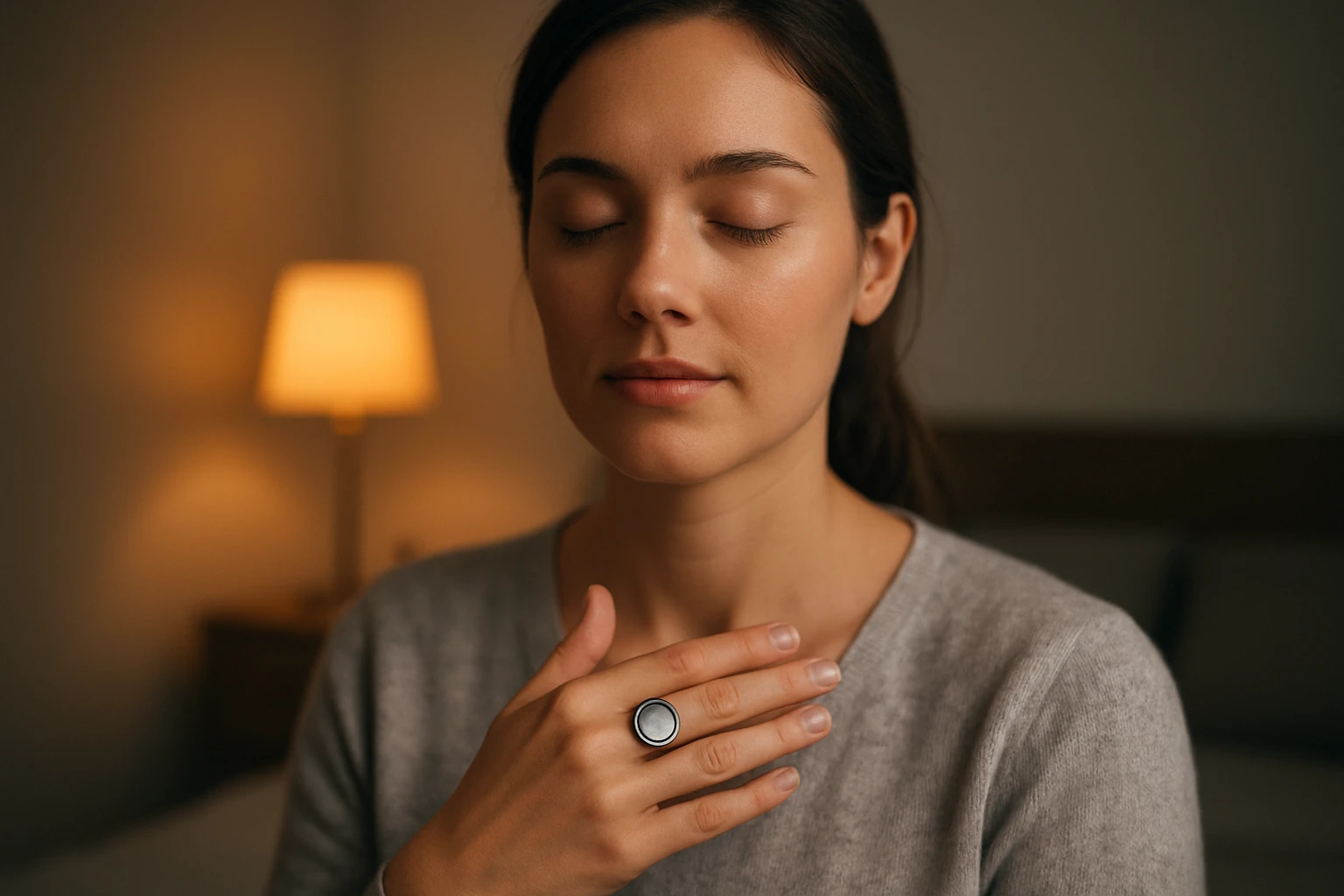
If you want better sleep, this is the section to take seriously. The body loves repetition at night. Same signals, same order, same general time. That’s how a tool becomes a cue instead of just another object on your nightstand.
Start 30 minutes before bed
Give yourself a 30-minute runway. Not three minutes after doomscrolling. Not once your head already hits the pillow and your mind is doing taxes. Set a reminder for 30 minutes before your target bedtime. That’s when the ring goes on, the lights soften, and the pace changes.
If midnight is your normal bedtime, start at 11:30. If you’re up with kids and life is chaos, aim for the same sequence rather than the same exact minute. Close is good enough. Predictable beats perfect.
Dim lights and reduce screens
Lower the light. Put the phone down. Turn off the overheads and use a lamp if you can. This isn’t about making your room aesthetic for Instagram. It’s about reducing input. Bright light and rapid-fire content tell your brain to stay alert.
A warm lamp, pajamas on the bed, a notebook on the nightstand, and your phone flipped face down can do a lot of heavy lifting. It’s boring in the best possible way. Calm likes boring.
Repeat the same breathing pattern every night
Use the exact same breath count you practiced earlier. Don’t switch to a new method because you saw a different one on YouTube. Keep it familiar. Ring on. Inhale 4. Exhale 6. Shoulders drop. A few quiet notes if you’re tracking. Then lights out.
The product page positions the Alpha + Charisma bundle as a day-and-night wearable duo, and that framing makes practical sense here. Whether you’re using the ring alone or as part of that pairing, the real win is predictability. Your body learns that this sequence means you’re powering down.
Bedtime rituals work because they are predictable, not because they are complicated.
Step 5: Track What Changes Over 7 Days
This is the part almost everyone skips. Then a week later they say, “I think I slept better? Maybe?” Memory is slippery, especially when you’re tired. Track it for seven days and you’ll see patterns faster than you think.
Record how long it takes to fall asleep
You do not need precision down to the minute. An estimate is fine. Was it 15 minutes? 40? An hour with your brain narrating every bad decision since 2019? Write a number that feels honest.
Over seven nights, that number becomes useful. One rough night means almost nothing. A trend from 50 minutes down to 25 is something you can actually work with.
Note night waking and morning mood
Write down how many times you woke up, plus how you felt in the morning. Not just “slept badly.” Be specific. “Woke twice, felt groggy.” “Woke once at 2:10 a.m., fell back asleep faster.” “Slept through, woke calmer.” Those details matter.
Morning mood is underrated. If your stress before bed drops from an 8 to a 5 and you wake less irritable, that counts — even before your sleep is perfect.
Change only one variable at a time
If you start the ring routine, quit caffeine, buy blackout curtains, take magnesium, and switch mattresses in the same week, you won’t know what helped. Keep one main experiment running at a time. That’s how you learn something useful.
Common sense applies here. Consistency makes it easier to see whether a routine is helping, and tracking sleep onset, wakeups, and mood gives you a simple before-and-after comparison.
| Day | Stress Before Bed (1-10) | Minutes to Fall Asleep | Wakeups | Morning Mood |
|---|---|---|---|---|
| Day 1 | ||||
| Day 2 | ||||
| Day 3 | ||||
| Day 4 | ||||
| Day 5 | ||||
| Day 6 | ||||
| Day 7 |
If you change everything at once, you won’t know what actually helped.
Common Mistakes to Avoid
When people say a calming tool “didn’t work,” the reason is often maddeningly ordinary. Wrong timing. No baseline. No repetition. Dead battery. Expectations set to movie-montage levels. Let’s clean that up.
Using it only when anxiety is already at a peak
If you wait until you’re already fully activated, the routine has a harder job. It can still help, sure, but that’s like learning to swim by getting tossed into rough water. Practice when you’re at a 4 or 5 too, not just at a 9.
That’s how the cue gets built. Then when the bigger wave comes, your body already knows the pattern.
Expecting it to replace medical or mental health care
This routine can support stress management. It is not a substitute for therapy, medical guidance, or urgent care when you need it. If anxiety is severe, persistent, or getting worse, bring in real support. A wearable can sit beside care. It should not stand in for it.
That matters even more if your symptoms include panic attacks, depression, chest pain, major sleep disruption, or anything that makes daily life hard to manage. Use the routine as one tool — not the whole toolbox.
Ignoring fit, charging, or comfort issues
The product page lists a battery, wireless connection, water resistance, and four biosensors. In plain English, that means upkeep is part of the job. If the ring isn’t charged, doesn’t feel right, or keeps distracting you, the ritual falls apart before it starts.
So troubleshoot the obvious stuff. Charge it consistently. Wear it the same way. Keep your setup uncluttered. If your nightstand looks like a cable graveyard at 12:03 a.m., your stress routine is already fighting uphill.
If anxiety is severe, persistent, or worsening, this routine should support care — not replace it.
This is why the most useful way to think about the ring is simple: not as a one-time cure, but as a repeatable cue paired with breath, tracking, and decent sleep hygiene.
If you’re learning how to use the charisma ring for stress relief, start smaller than your anxious brain wants — five quiet minutes, the same breath count, and seven honest days of notes.
What do you notice first: a looser jaw, fewer 2 a.m. wakeups, or that tiny pause before your mind starts sprinting?
Explore Calmer Living With Anywhere Healing
Anywhere Healing pairs advanced biosensors that read the body’s signals with precise frequency support to encourage natural recovery for calmer stress, steadier sleep, and drug-free balance.
Explore Relief


