

Non Pharmaceutical Pain Management: A Wearable-First 6-Step Plan to Reduce Pain, Stress, and Improve Sleep
At 2 a.m., you wake up with a stiff back, roll onto your side, and glance at your sleep data. Six hours. Too many wake-ups. You can already feel the math: yesterday’s pain made you tense, the tension wrecked your sleep, and the bad sleep is about to make everything hurt more by breakfast.
That loop is exactly why non pharmaceutical pain management can feel so frustrating. You want relief, obviously. But do you stretch? Rest? Walk? Breathe? Change your bedtime? After enough of these nights — and after seeing how often people guess wrong because they change everything at once — I’ve become a big believer in a measurement-first routine. A wearable won’t solve pain by itself, but it can help you stop flying blind.
MedlinePlus, Stanford Health Care, and the CDC use slightly different language here: non-drug, non-pharmacological, nonopioid. Same neighborhood. The practical idea is simple: use habits, awareness, and targeted daily actions to reduce pain, lower stress, and improve sleep without making medication your only plan. Let’s build that system step by step.
Start Here: Set a Baseline and Gather Your Tools
What non-pharmaceutical pain management means
Watch This Helpful Video
To help you better understand non pharmaceutical pain management, we've included this informative video from ICU REACH. It provides valuable insights and visual demonstrations that complement the written content.
Stanford Health Care defines non-pharmacological pain management as managing pain without medications. Stanford also notes that these approaches can include education and psychological conditioning, which sounds formal but plays out in very everyday ways: understanding your triggers, changing your response to pain spikes, and using focus to calm the system instead of feeding the spiral.
MedlinePlus puts the first principle plainly: pain is a signal in your nervous system that something may be wrong. That matters. Pain is real, useful, and personal — but it isn’t always a command to panic. Your job is to learn what your signals are doing, then respond with a little more precision.
If the pain is sudden, severe, or tied to a fresh injury, treat this plan as support — not a substitute for medical evaluation.
Your wearable-first starter kit
You do not need a lab. You need a handful of simple tools and one week of consistency. A basic wearable, a phone app, or a simple reminder device can work. Fancy is optional. Repeatable is not.
- A wearable or device that helps track sleep, activity, or body signals
- A notebook, notes app, or spreadsheet for symptom logging
- A pain scale you’ll actually use, such as 0 to 10
- A consistent morning and evening check-in time
- Comfortable shoes or a clear space for short movement breaks
| Tool | Minimum Version | Why It Helps |
|---|---|---|
| Wearable | Sleep and step tracking | Shows patterns in rest, movement, and reminders |
| Log | Paper notebook or phone notes | Captures pain quality, timing, and triggers |
| Timer | Phone or watch alert | Keeps breathing, walks, and wind-down routines consistent |
| Weekly review slot | 15 minutes on the same day | Helps you notice trends instead of reacting to one bad day |
Safety check: when self-management is not enough
I’ll say this plainly because people skip it. Self-management works best when you’re dealing with patterns you already recognize: recurring stiffness, stress-linked tension, sleep disruption, the usual ache that follows too much sitting. It is not your home version of an emergency department.
Get medical help quickly if you have sudden severe pain, chest pain, trouble breathing, major weakness, new numbness, a fresh injury with swelling or deformity, fever with unexplained pain, or changes in bowel or bladder control. If you’re dealing with cancer treatment, post-surgical pain, or a complicated condition, bring this plan to your clinician and adapt it together.
Step 1: Track Pain, Stress, and Sleep for 7 Days
Choose three daily metrics: pain, stress, and sleep
Start with three things only. Pain. Stress. Sleep. That’s enough to tell you a lot. For pain, log a 0-to-10 score, the body area, and a quick description. MedlinePlus notes that pain can be sharp or dull, come and go, or be constant. That quick word choice matters more than people think. “Stiff and achy at 7 a.m.” is different from “sharp and worsening after lunch.”
For stress, use the same 0-to-10 scale. Don’t overcomplicate it. For sleep, record hours slept, number of wake-ups if your wearable shows them, and a simple quality note like “restless” or “solid.” MedlinePlus also reminds us that each person feels pain differently, even when the reason is the same. That’s why your baseline beats anybody else’s template.
| Time | What to Log | Example |
|---|---|---|
| Morning | Sleep, pain, stiffness | 6.5 hours, 3 wake-ups, pain 6/10, low-back stiffness |
| Midday | Stress, pain change, activity | Stress 7/10 after meetings, pain 5/10 after short walk |
| Evening | Pain, mood, bedtime plan | Pain 4/10, calmer after breathing, lights out at 10:30 |
Log the same times every day
Consistency beats detail. Pick the same three checkpoints every day for seven days — for example, 7 a.m., 2 p.m., and 9 p.m. If you only log when you feel terrible, your notes will make your life look worse than it really is. If you only log on your “good” days, you’ll fool yourself the other way.
Wearables help here because they reduce friction. Your morning sleep data is already sitting there. Your step count is already sitting there. You can set a buzz on your wrist at 2 p.m. so you don’t have to rely on memory, which is famously unreliable when pain is involved.
Look for patterns, not perfection
During this first week, resist the urge to fix everything. I know. That’s hard. You’ll be tempted to start magnesium, swap your chair, do yoga, quit coffee, buy a new pillow, and become a different person by Thursday. Don’t. You want a clean baseline first.
Don’t change five things at once; collect a clean baseline first so you know what actually moves the needle.
What you’re watching for is pattern recognition. Maybe your pain is worst after two hours at the desk. Maybe stress hits 8 out of 10 on days with back-to-back calls. Maybe your sleep score drops every time dinner happens at 9 p.m. Those clues are gold.
Step 2: Match Activity to the Pain Signal
Tell acute from ongoing pain
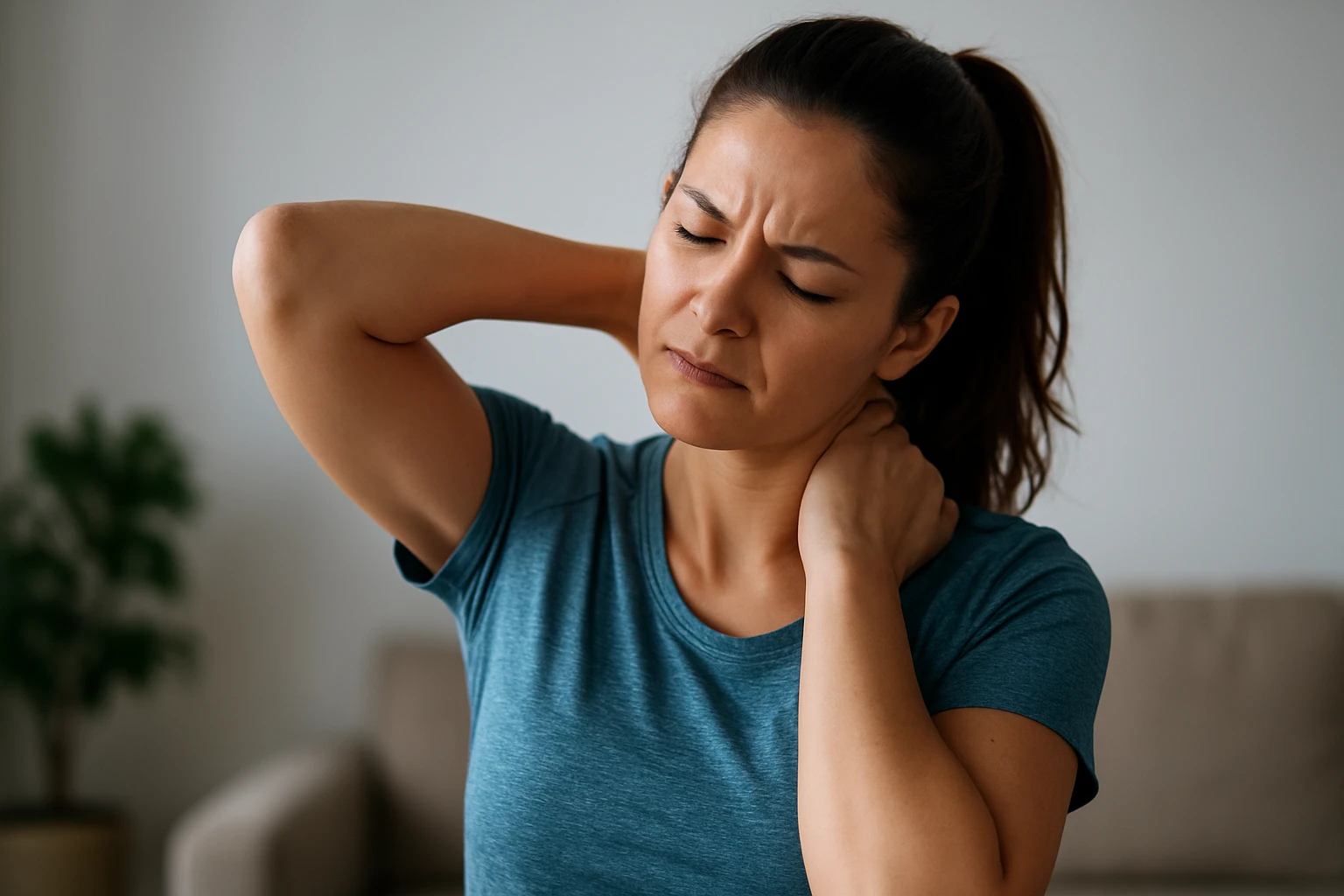
This is where people usually overcorrect. MedlinePlus says acute pain usually comes on suddenly because of disease, injury, or inflammation, and it usually goes away when the cause is treated or healed. That’s different from the familiar stiffness that builds after too much sitting or the nagging ache that shows up after a stressful day.
If the pain is new, sudden, and clearly linked to a twist, fall, or fresh strain, you respond differently than you would to your standard “I sat in one position for four hours and now my hips hate me” pain. Your wearable can support this step by showing whether you’ve been inactive for long stretches or unusually active, but it cannot tell you what an injury is.
| Pain Pattern | What It Often Feels Like | First Response |
|---|---|---|
| Sudden acute pain | Sharp, immediate, tied to injury or inflammation | Stop, assess, rest, and seek medical input if needed |
| Stiffness from inactivity | Dull, tight, worse after sitting | Try gentle movement and a short walk |
| Escalating pain | Increasing intensity, swelling, heat, or instability | Back off and reassess rather than pushing through |
Use low-effort movement when stiffness is the issue
If your log shows that pain eases after you stand up, walk for five minutes, or loosen your shoulders, that’s a clue. Stiffness likes circulation. I’ve seen this pattern again and again with desk workers and frequent travelers. They assume they need a heroic workout, when what they actually need is six tiny resets between 9 a.m. and 5 p.m.
Try one of these first: a five-minute walk, ten bodyweight sit-to-stands from a chair, gentle spinal rotation, shoulder rolls, or a slow lap around the house. Let the movement be boring. Boring works.
Use rest when the signal is clearly escalating
There’s a macho version of pain advice that tells you to push through everything. That advice has wrecked plenty of knees, backs, and recovery weeks. If each step makes the pain sharper, if you notice swelling or heat, or if the body part feels unstable, stop trying to “win” the moment. Rest is not quitting. It’s information.
The goal is not to ignore pain; it’s to respond to the kind of pain you actually have.
A watch reminder to move is helpful. It is not a commandment. If your body is telling you this is not a stiffness problem, listen.
Step 3: Use Breath and Focus Breaks to Turn Down Stress
Add 3-5 minute breathing resets
Stanford Health Care says non-pharmacological pain management can work by altering thoughts and focusing concentration to better manage and reduce pain. That sounds academic, but in practice it can be as simple as three minutes of slower breathing. Guided breathing, relaxation, and mindfulness are common non-drug tools for a reason: they’re short, free, and surprisingly effective when you actually do them.
My favorite starter pattern is 4 seconds in, 6 seconds out, for 3 minutes. If you prefer structure, set a 5-minute timer on your watch. Hand on chest. Feet on floor. Eyes closed if that helps. Nothing mystical — just a nervous system reset.
Pair a stress break with every pain spike
Here’s a trick that changed this from “nice idea” to useful routine for me: every time pain jumps by 2 points, I do a short stress break before I decide what comes next. Not after. Before. That might be breathing, a body scan, or sixty seconds of sitting quietly with no screen in my face.
Why bother? Because pain and stress love to amplify each other. If your shoulders climb toward your ears the minute pain shows up, the next move shouldn’t always be another stretch. Sometimes it should be de-escalation first, then movement.
Use wearable alerts as a cue, not a judgment
This is a subtle one. If your wearable flags high stress, low readiness, or just buzzes to remind you to pause, treat it like a friendly tap on the shoulder. Not a verdict on your health. Overreacting to every fluctuation works against the whole point of focusing your attention in a calmer way.
Use the wearable to interrupt the spiral, not to obsess over every fluctuation.
If alerts make you more anxious, scale them back. One breathing reminder at 11 a.m. and another at 4 p.m. is plenty for most people.
Step 4: Build Pain-Friendly Movement into the Day
Schedule micro-walks and mobility breaks
MedlinePlus says pain can show up in one area — the back, abdomen, chest, or pelvis — or all over. It can feel like a prick, tingle, sting, burn, or ache. With that much variation, rigid exercise plans often miss the mark. What works better for many people is a string of small, low-drama movement snacks.
Try 3 to 10 minutes every hour or two. A lap around the block. A slow set of calf raises. Gentle neck turns. Hip circles while the kettle boils. If your watch already reminds you to stand, great — keep that feature on and actually honor it.
Reduce long static positions
Static positions are sneaky. Sitting for 90 minutes can bother one body. Standing in place for 90 minutes can bother another. The problem is rarely “sitting is evil” or “standing is better.” The problem is staying frozen. If your logs show a pain spike after long meetings, long drives, or an afternoon on the couch, break the stillness sooner.
One easy rule: if you notice you’ve been in the same posture for 30 to 45 minutes, change something. Stand. Sit. Walk. Reach overhead. Shift the pattern.
Match movement intensity to your baseline
This is where ambition gets people in trouble. If your average is 2,500 steps a day, tomorrow is not the day to chase 10,000 because you finally feel motivated. Build from where you are, not from where your ideal self lives in your imagination.
Small, repeatable movement often beats one ambitious workout that leaves you sore for two days.
Look at your week-one data, then add a little. A second short walk. One extra stretch break. Five more minutes of movement in total. That’s how you make progress without picking a fight with your nervous system.
Step 5: Make Sleep Part of the Pain Plan
Set a consistent wind-down window

Sleep is not the dessert course of pain care. It’s the foundation. If pain may come and go or stay constant, as MedlinePlus notes, then you need a nightly routine that gives your body a predictable runway. Pick a wind-down window — 30, 45, or 60 minutes — and protect it more fiercely than you protect most email.
Lower lights. Put the phone face down. Skip the late-night argument with the internet. If you like structure, use your wearable or phone to trigger a “bed soon” reminder at the same time each night. People underestimate how much regular timing helps.
Use sleep data to spot patterns
Wearable sleep tracking can help identify bedtime patterns and nighttime awakenings. No, it’s not a sleep lab. Yes, it’s still useful. If your sleep score tanks every Wednesday after a late workout, or your wake-ups increase when stress peaks above 7 out of 10, that’s actionable.
The CDC has a dedicated resource titled Nonopioid Therapies for Pain Management. I like mentioning that because it reminds people this kind of approach is not fringe. Sleep, movement, stress regulation, and other non-drug tools belong squarely in the pain conversation.
Protect the room, the routine, and the timing
Three things matter more than most people want them to. The room: cool, dark, quiet enough. The routine: roughly the same order each night. The timing: consistent enough that your body isn’t guessing whether bedtime is 10 p.m. or midnight. Blackout curtains are not glamorous, but they beat a motivational speech every time.
Don’t wait for pain to improve before fixing sleep; better sleep is part of the plan.
If you wake at 2 a.m. again, don’t start troubleshooting your whole life from the pillow. Jot one note in the morning, review the pattern later, and keep the nighttime response calm.
Step 6: Review the Data and Adjust the Routine
Compare trends in pain, stress, and sleep
This is where the plan pays off. Once a week — Sunday morning works well for a lot of people — sit down with your wearable data and your notes for 10 to 15 minutes. Look at averages, not dramatic single moments. MedlinePlus emphasizes that each person feels pain differently, even when the cause is the same, so your review is about your own trend line, not somebody else’s social post or recovery story.
| If You Notice | What It May Mean | Next Move |
|---|---|---|
| Pain drops after short walks | Stiffness responds to movement | Keep movement breaks; make them more consistent |
| Stress spikes before pain worsens | Tension may be amplifying symptoms | Add breathing before expected stress periods |
| Sleep worsens after late meals or screens | Bedtime routine needs tightening | Move dinner earlier; start wind-down sooner |
| No clear change after 2-4 weeks | Too many variables or wrong focus | Simplify the routine and reassess |
Decide what to keep, reduce, or add
Stanford Health Care describes these methods as ways to better manage and reduce pain. Weekly review is how that actually happens. Keep the habits that help at least one metric without hurting the others. Reduce the habits that create soreness, stress, or bedtime chaos. Add only one new variable at a time.
A good weekly decision list looks like this:
- Keep the 10-minute after-lunch walk.
- Move evening stretching earlier because it wakes me up.
- Add one 3-minute breathing break before the 3 p.m. meeting.
That’s enough. You are editing a routine, not auditioning for sainthood.
Know when to escalate care
If your plan is producing small wins, great — stay with it. If symptoms are worsening, changing shape, or not improving at all, don’t pile on more hacks. Get help. Bring your seven-day or four-week log to a clinician, physical therapist, or other qualified professional. Good data shortens the conversation.
If nothing is changing after two to four weeks, simplify the plan and reassess rather than adding more variables.
A wearable can help you see patterns. It cannot diagnose the reason behind them. Keep that line bright.
Common Mistakes to Avoid in Non Pharmaceutical Pain Management
Chasing every number instead of the trend
One rough night does not erase six improving days. One bad sleep score does not mean your plan failed. MedlinePlus says pain can come and go or be constant, which is exactly why daily swings need context. Trend first. Drama second.
If you’re checking the app 18 times a day and feeling worse each time, you’re not using data anymore. Data is using you.
Doing too much too soon
This one usually shows up as a burst of motivation on a “good” day. You clean the garage, double your steps, stretch for 40 minutes, stay up late because you finally feel normal, and then Thursday feels like punishment. I’ve done this myself. It’s annoying because it feels productive right up until it doesn’t.
Scale slow enough that tomorrow still works. That’s how you build trust with your body instead of whiplash.
Ignoring red flags or new symptoms
Stanford frames non-pharmacological pain management as a way to alter thoughts and focus concentration. That only helps when you stay grounded in reality. A wearable is a self-management aid, not a diagnostic tool. New weakness, severe swelling, major function loss, chest symptoms, or pain that feels alarmingly different deserves real evaluation.
Data should guide behavior, not create anxiety.
If you remember only one thing from this section, let it be that. Calm interpretation beats constant monitoring.
This plan works because it turns non pharmaceutical pain management into a steady loop: measure, respond, recover, and adjust.
You do not need perfect data or a perfect body. You need a week of honest tracking, a few habits you can repeat on ordinary Tuesdays, and the patience to trust trends over mood.
If you started tonight, what would your first seven days of pain, stress, and sleep reveal?
Find Steadier Relief With Anywhere Healing
Biosensor-guided, precise frequency delivery can ease pain, support deeper sleep, and help your body regain balance through a non-invasive, drug-free wearable approach.
Explore Relief


