

Charisma Ring for Stress Relief and Sleep Support: A Practical Guide to Frequency-Based Wearable Therapy for Calm, Deep Sleep
At 11:47 p.m., the bedroom lights click off, the phone goes face-down on the nightstand, and one small ring becomes part of the wind-down routine. A glass of water sits beside a notebook with two half-legible lines in it. The room is quiet, but your mind is not. It is doing what minds love to do at night: replaying Tuesday, previewing Thursday, and wondering whether you forgot to answer that 3:14 p.m. email.
That is exactly why the idea of a charisma ring for stress relief and sleep support sounds appealing. Not because it promises magic, but because it offers a cue — a repeatable, wearable signal that says, “We are shifting gears now.” If you are looking for something non-invasive and drug-free, especially when stress, poor sleep, or just general overstimulation keep showing up together, a tool like this can be worth a serious look.
I have spent enough nights testing sleep routines, trackers, and “calming” gadgets to know one thing: the helpful ones usually win in a boring way. They make you more consistent. They lower friction. They help you actually do the habits you already know matter, whether that is dimming lights at 10:15, cutting off caffeine after lunch, or stopping the doom-scroll before it becomes a midnight hobby.
Introduction: What a charisma ring is and why people use it
What the ring is marketed to do
Watch This Helpful Video
To help you better understand charisma ring for stress relief and sleep support, we've included this informative video from Mindrest. It provides valuable insights and visual demonstrations that complement the written content.
On the product page from Anywhere Healing, the Charisma Ring is described as a frequency-driven wearable designed to help users feel calmer and more centered. The same page highlights support for stress relief and says it may help with focus and daily stress. That wording matters. It tells you the product is positioned first as a nervous-system and mood support tool, not as a sleep medication or a replacement for a full sleep program.
So why does sleep enter the conversation at all? Simple. For a lot of people, bedtime is where daytime stress cashes out. You do not fall asleep late because the clock is broken. You fall asleep late because your body still feels “on.” If a wearable helps you feel a little less revved up at 10:30 p.m., sleep may improve as a downstream effect. That is a reasonable hope. It is very different from promising that a ring will knock you out like a sedative.
If a wearable promises calm, the first question is not “Does it sound advanced?” but “What habit does it actually help me keep?”
Who this guide is for
This is for you if you are curious about non-invasive, drug-free wellness tools for stress, sleep issues, pain/discomfort support, or those fuzzy “something feels off” stretches when your body just will not settle. It is also for you if you like ritual. Some people genuinely do better when they can anchor a habit to an object — a ring tray, a lamp, a journal, a breathing app, a cup of chamomile at 10 p.m.
It is not really for you if you want certainty in a tiny box. If you are dealing with severe insomnia, panic symptoms, loud snoring, gasping awake, or months of bone-deep exhaustion, a ring should not be your only move. A wearable can live inside a bigger care plan. It should not replace one.
What results to expect realistically
Realistic results look small at first. You might feel a smoother transition into bed. You might notice less fidgety tension in the hour before sleep. You might fall asleep 15 or 20 minutes faster after a week of consistent use. You might wake up feeling less “wired tired.” Those are meaningful changes, especially if your nights have been messy for a while.
What should you not expect? Instant transformation after one night. Perfect sleep every night. Guaranteed calm before every hard conversation. The product language itself uses phrases like “may enhance” and “believed to support,” which is a big clue that you are dealing with possibility, not certainty.
If you treat the ring like a routine tool, you are likely to judge it fairly. If you treat it like a magic fix, you will probably be disappointed by Friday.
Fundamentals of a charisma ring for stress relief and sleep support
Design and materials
The first things buyers notice are the obvious ones: it has a titanium build, a sleek design, and it looks like jewelry instead of a mini science project. That matters more than people admit. If a ring looks awkward, feels bulky, or clashes with daily wear, it ends up in a drawer by day four. Titanium is appealing because it is durable, light, and generally well suited to everyday use — think dish soap, gym bags, laptop edges, and all the other abuse a ring catches between breakfast and bedtime.
Design, though, is not the same thing as therapeutic value. A polished finish can make you trust a device faster. It cannot prove what the device does.
Claimed biosensor features
The product page also highlights “Dual Biosensors.” In plain terms, that means the ring is presented as more than decorative jewelry. It includes a red infrared frequency emitter and a green photoplethysmography sensor. If you have seen green lights on a smartwatch, you have already seen the general family of technology involved in PPG sensing.
| Feature | Why it matters to a buyer | What it does not prove |
|---|---|---|
| Titanium build | Durability, lightweight feel, everyday wearability | Better sleep or stress relief on its own |
| Dual biosensors | Suggests the ring is sensing and delivering something, not just decorating | That the claimed mechanism is clinically validated |
| Infrared emitter | Signals a wellness-tech approach rather than simple jewelry | That deep tissue effects translate into better sleep for you |
| PPG sensor | Uses a familiar wearable sensing method | That data collection equals meaningful therapeutic change |
This distinction sounds nitpicky, but it saves you money and frustration. Product features tell you what a device is built with. They do not automatically tell you what the device can reliably change in your life.
Warranty, fit, and everyday wear
A 3-year warranty is one practical detail worth paying attention to. Not because a warranty proves health benefit — it does not — but because it says something about how the manufacturer wants you to view build quality and durability. If you are going to wear something daily, that matters.
Fit matters just as much. Rings that feel fine at 2 p.m. can feel tight at 11 p.m., especially if your hands swell a little in the evening or after a salty dinner. Try to think like a real person, not an optimistic shopper. Will this still feel comfortable while reading in bed? During travel? On a warm day in July? If the answer is no, your “daily wellness tool” may turn into occasional nightstand decor.
A polished material and a long warranty can improve trust, but they do not by themselves prove therapeutic benefit.
How it works
Low-frequency resonance and emotional regulation
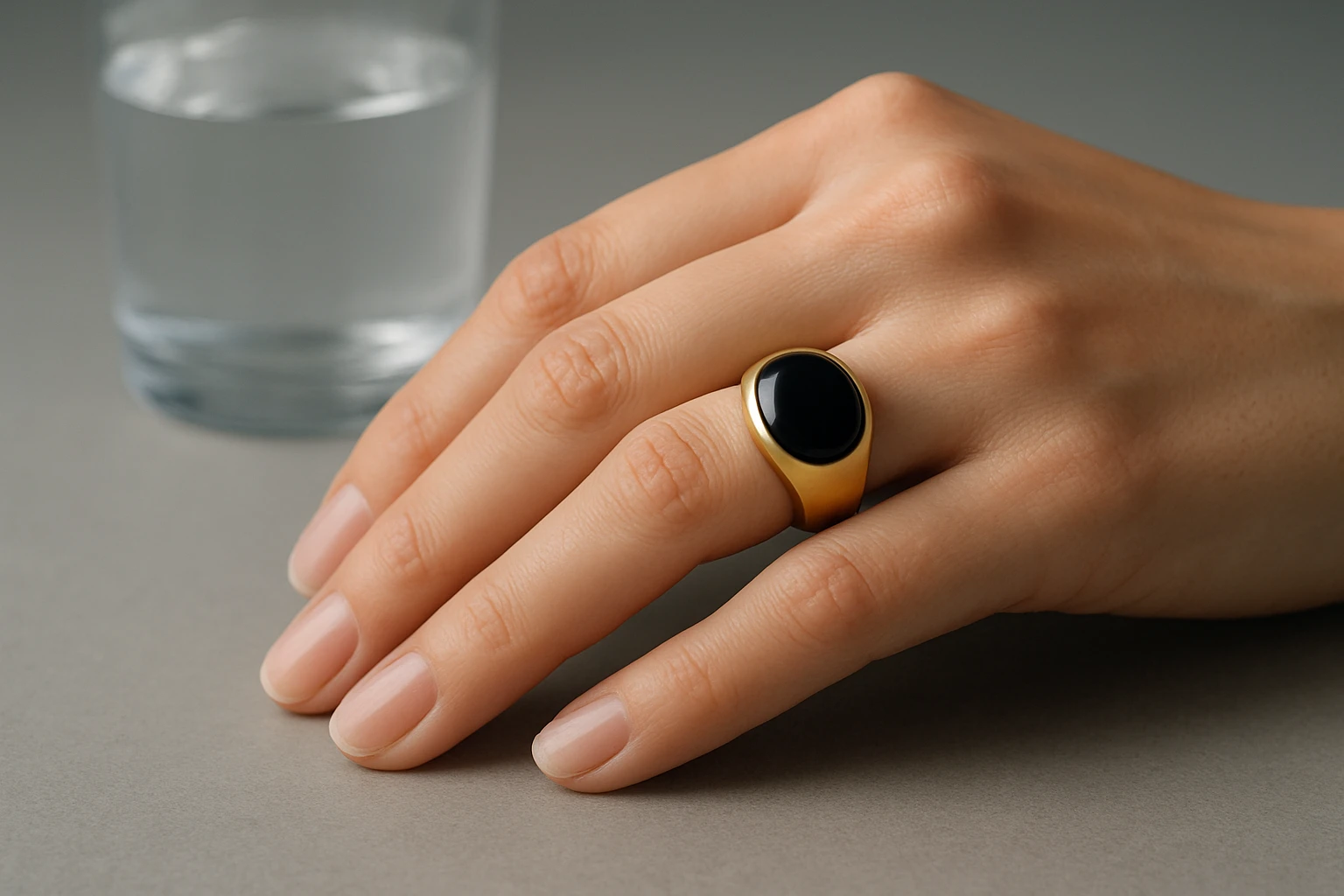
Now let’s translate the marketing language into regular human speech. The product page says the ring emits low-frequency resonance patterns believed to support a calmer internal state. Put more simply, the claim is that the ring sends subtle patterned signals intended to encourage steadier relaxation.
That idea will sound intuitive to some people and vague to others. Both reactions are fair. We already know routines, light exposure, breath pacing, and repetitive cues can influence how wound up you feel. The open question is not whether your nervous system responds to inputs. It does. The real question is whether this specific input, in this specific form, produces a meaningful result for you.
Infrared and photoplethysmography explained simply
The red sensor is described as an infrared biosensor that emits gentle frequencies and is said to penetrate deep into tissues. That is the product claim. Infrared shows up in lots of devices, from household remotes to therapy tools, so the word itself should not hypnotize you. Context matters. Delivery matters. Outcomes matter.
The green sensor is easier to demystify. Photoplethysmography, or PPG, is a light-based sensing method commonly used in wearables to detect blood-volume changes and pulse-related signals. Apple Watch, Fitbit, and other wrist wearables use related sensing ideas. In other words, this part of the ring is not sci-fi. It fits into the broader world of wearable physiology tracking.
Where buyers sometimes get confused is assuming that because PPG is common and real, every biosignal-based wellness claim surrounding it must also be established. That leap is too big. A familiar sensor can make a device more plausible. It does not do the whole evidentiary job for the product.
Why “believed to support” matters
Those three words — “believed to support” — are doing a lot of work. You will also see phrases like “may enhance” and “designed to help.” None of that means the product is useless. It means the language is suggestive rather than definitive.
When I read wellness product pages, I mentally sort statements into three buckets. First: design facts, like titanium or a 3-year warranty. Second: mechanism claims, like low-frequency resonance or infrared emission. Third: outcome claims, like calmer moods or reduced daily stress. You should not treat all three buckets as equally proven just because they sit on the same page.
The phrase “believed to support” signals a claim, not proof; careful readers should treat mechanism language as a starting point for evaluation.
If that sounds cautious, good. Caution is what keeps you from confusing smart copywriting with settled evidence.
Best Practices for a Charisma Ring for Stress Relief and Sleep Support
When to wear it during the day and evening
If a ring like this helps at all, it will probably help most when you use it consistently around predictable stress points. For some people, that is the 8:30 a.m. commute, the 3 p.m. Zoom call, or the school pickup rush. For sleep support, the highest-value window is usually the hour before bed, when your job is not to be productive but to stop accelerating.
A simple starting pattern works well: wear it during one daytime stress block and again during your evening wind-down. Do that for 10 to 14 nights before you decide whether it belongs in your routine. A Wednesday test followed by a Sunday judgment tells you almost nothing.
Pairing it with sleep hygiene habits
This is where people either get results or quietly sabotage themselves. A calming accessory works best when it sits inside actual sleep hygiene. That means a regular bedtime, a regular wake time, dimmer light at night, less screen exposure, and a bedroom that feels like a place to sleep instead of a second office.
- Pick a bedtime and wake time you can repeat, even on weekends.
- Dim overhead lights 30 to 60 minutes before bed.
- Put the phone face-down or, better yet, out of reach.
- Watch late caffeine and heavy evening meals.
- Keep a small ritual: ring on, lamp low, two notebook lines, maybe five slow breaths.
When I tightened my own routine to a 10:30 lights-out target and stopped pretending a 4 p.m. coffee was “small,” every other tool worked better. Funny how that goes. The ring did not create calm from nowhere. It helped me remember to stop behaving like it was noon.
Use the ring as an anchor for a routine, not as proof that the routine is working.
How to track whether it helps
You do not need a lab. You need a notepad and honesty. Track sleep onset time, nighttime awakenings, and morning mood for at least two weeks. If you use an app or a tracker, fine — but keep a simple written note too. Subjective experience matters here. Sometimes your tracker says six hours and 58 minutes, but the bigger story is that you woke up less frazzled and stopped dreading bedtime.
| What to track | How to log it | Why it matters |
|---|---|---|
| Time you tried to sleep | Write down lights-out time each night | Shows whether your schedule is actually consistent |
| Sleep onset | Estimate how long it took to fall asleep | Useful for seeing whether bedtime calm improves |
| Night awakenings | Note how many times you woke up and for how long | Helps separate “fell asleep faster” from “slept better” |
| Morning mood | Rate 1 to 5 when you wake up | Captures the next-day effect, not just the night itself |
| Routine adherence | Yes or no: wore ring, dimmed lights, reduced screens | Keeps you from crediting or blaming the wrong variable |
One great night after pizza, wine, and a lucky crash does not tell you much. Patterns do.
Common mistakes
Expecting instant relief
This one is everywhere. You put the ring on Monday, sleep badly Tuesday, and decide the whole concept is nonsense by Wednesday breakfast. That is not testing. That is speed-dating a wellness tool.
Most disappointment with wearables comes from timeline mismatch. Buyers expect a dramatic overnight effect, while the actual best-case scenario is usually gradual: a calmer pre-sleep state, easier sleep onset, slightly steadier mornings, less bedtime dread after a week or two.
Using it without a larger routine
If the ring goes on while the laptop stays open, the TV runs bright, and you are still replying to Slack at 12:13 a.m., do not expect much. The ring cannot outmuscle chaos. It can support a downshift. It cannot create one while you are stomping the gas.
I see this all the time with gadgets people genuinely want to love. They buy the tool, skip the behavior change, and then blame the tool alone. Sometimes that blame is deserved. Often it is shared.
Confusing marketing claims with evidence
Read benefit language carefully. “May enhance” is not “will improve.” “Believed to support” is not “proven to deliver.” That does not mean you should roll your eyes at every product page. It means you should keep your standards intact while staying open-minded.
If a page sounds absolute, slow down. Ask what is a build feature, what is a mechanism claim, and what is an outcome claim. Ask whether the evidence is shown, implied, or simply suggested through language that sounds scientific. In this category, that distinction is everything.
If the promise sounds absolute, the evidence usually is not.
Tools and resources
What to compare on the product page
Before you buy — or before you keep using what you already bought — compare the basics that actually affect real life. On this product page, the headline features are dual biosensors, titanium build, sleek design, and a 3-year warranty. Those are reasonable things to compare against similar products. But also compare what kind of product you are even looking at, because search results in this space mix very different categories.
| Type of ring | Main idea | What to compare |
|---|---|---|
| Biosignal wearable | Uses sensors and frequency-based wellness claims | Mechanism clarity, comfort, warranty, return policy, routine fit |
| Fidget ring | Provides tactile movement for nervous energy | Spin feel, durability, distraction value, style |
| Meditation or decorative ring | Acts as a symbolic mindfulness cue | Comfort, wearability, whether the ritual helps you stick with habits |
That matters because the search landscape here is thin and messy. One result is clearly a fidget ring. Another is positioned as meditation jewelry. One reference failed to scrape, and another returned a 404 page. When the information stack is that patchy, you need to be extra careful about assuming that all “charisma rings” are making the same claim.
What to ask about safety and fit
Keep your questions practical. Does the ring fit comfortably at night, not just in the middle of the day? How easy is it to clean? What is the return window if the size is off? Does the finish irritate your skin after several hours? Is it meant for constant wear or only certain periods?
And ask the bigger safety question too: are you using a wellness gadget to avoid addressing a sleep problem that needs proper attention? If you snore heavily, wake up gasping, get morning headaches, or feel exhausted no matter how long you are in bed, do not let a ring delay a real workup.
What to monitor over time
Over a two-week or three-week stretch, monitor four things: comfort, consistency, changes in your bedtime routine, and changes in your nights. Comfort tells you whether daily use is realistic. Consistency tells you whether you gave it a fair test. Routine change tells you whether the ring is acting like a useful cue. Night change tells you whether the cue seems to matter.
If the ring spends 12 nights on the tray and two nights on your finger, that is useful information. If you wear it nightly but still go to bed at wildly different times, that is useful too. If you become more consistent and your sleep onset drops from 50 minutes to 25, now you have something worth paying attention to.
A good comparison list should include evidence quality, comfort, return policy, and whether the ring actually improves your nightly routine.
A charisma ring can earn its place on your nightstand when it supports the boring stuff that actually changes sleep — dim light, steady timing, a calmer nervous system, and honest tracking.
That grounded approach is the real promise of a charisma ring for stress relief and sleep support: less fantasy, more routine. What would you need to see over the next 14 nights to call it genuinely helpful?
Feel Steadier Nights With Anywhere Healing
Anywhere Healing uses biosignal-based technology to support calm, rest, and balance through non-invasive wearable wellness support.
Explore Relief


