

Can Frequency-Based Wellness Help Support Better Balance? How Biosensor Devices Detect Disruption and Deliver Calming Signals
At 11 p.m., you’re lying in bed with a notebook open on the duvet, a small device on your wrist, and one question written across the top of the page: did tonight actually feel different? That’s the real version of the question can frequency-based wellness help support better balance — not the shiny ad version, the Tuesday-night version.
You don’t need a pep talk. You need a fair test. Harvard Health points out that stress can affect sleep, mood, and appetite, and that the long-term effects of chronic stress have been linked to cardiovascular disease, obesity, and Alzheimer’s disease. It also says defining stress is tricky. Exactly. If the thing you’re measuring keeps changing shape, your results get muddy fast.
I’ve run enough self-experiments to know where people get lost. They change five variables at once, forget what “better” meant, then decide based on vibes. A biosensor-based wellness device may read a body signal and guide a programmed frequency pattern, but whether that changes your sleep, pain, or sense of calm is something your own notes need to answer. Not marketing. Not cynicism. Your notes.
Intro checklist: Decide whether a frequency-based wellness test is worth your time
Name the one problem you want to change
Watch This Helpful Video
To help you better understand can wearable frequencies help restore cellular balance, we've included this informative video from David Wong - Quantum Visionary. It provides valuable insights and visual demonstrations that complement the written content.
Start smaller than “I want more balance.” That sounds nice, but you can’t measure it. Pick one stubborn, ordinary problem: taking 45 minutes to fall asleep, waking at 3:12 a.m., tight shoulders after laptop work, a stress spike before dinner, jaw clenching on work nights. I made this mistake years ago and wrote “feel more grounded” in my own notebook. Useless. I had no idea what counted as progress.
- Write one symptom in plain language.
- Add when it shows up: “after 9 p.m.” or “during afternoon meetings.”
- Define success with a number or behavior: “fall asleep within 20 minutes” or “reduce neck pain from 6/10 to 4/10.”
Separate wellness experiments from medical treatment
This matters. A wearable routine might help you relax, unwind, or settle into sleep. That is not the same thing as diagnosing why you feel bad. If you have new chest pain, fainting, severe insomnia, sudden neurological symptoms, or a mental health crisis, don’t turn a home experiment into a substitute for care. Keep your prescribed treatment steady unless your clinician tells you otherwise.
- Keep medical care and symptom tracking separate in your mind.
- Don’t stop medication just to make the test “cleaner.”
- Use the experiment for observation, not self-diagnosis.
Set a short test window before you begin
Give yourself a finish line. Seven nights is a solid start. Ten sessions works too. Short enough to finish honestly, long enough to spot a pattern. If you leave the timeline open-ended, novelty and wishful thinking creep in. You’ll start interpreting every random good night like it came with a halo.
- Choose your start date.
- Choose your end date.
- Decide what you will track every single session.
If you cannot name the symptom, you cannot honestly judge the result.
Pre-work checklist: Can frequency-based wellness help with your specific symptom?
Write down your top three symptoms
Before you test anything, list your top three symptoms in rank order. Not twenty. Three. Your body is noisy, life is noisy, and you need a short list you’ll actually keep up with. A decent example looks like this:
- Sleep onset: takes about 50 minutes on 4 nights a week.
- Stress: feels like a 7/10 between 8 p.m. and bedtime.
- Pain: low-back ache hits 6/10 after sitting through a long day.
That’s specific enough to test. If your symptom list reads like a novel, tighten it. Your goal here isn’t to capture your whole autobiography. It’s to build a usable baseline.
Log your baseline for sleep, pain, and stress
Spend a few days tracking before you start the wearable routine. Three baseline days are better than none. Seven are even better if you can stand it. Because stress can affect sleep, mood, and appetite, a baseline helps separate the device from everything else happening in your week — the bad meeting on Monday, the extra coffee on Wednesday, the takeout dinner on Friday.
| Metric | How To Track It | Example Entry |
|---|---|---|
| Sleep onset | Minutes from lights out to sleep | 42 minutes |
| Night waking | Number of wake-ups | 2 times |
| Stress | 1–10 rating before bed | 7/10 |
| Pain | 1–10 rating in the target area | 6/10 neck tension |
| Appetite | Low, normal, or high | Low after work |
Also, be honest about anything you already use. Some wellness pages describe 432 hertz audio as warmer, rounder, and easier on the nervous system. Maybe that matches your experience. Maybe it doesn’t. Either way, write it down if it’s part of your evening. Otherwise you’ll end up crediting the wrong thing.
List medications, caffeine, and bedtime habits
This is the unglamorous part, and it’s where clean results come from. If you take magnesium, sleep medication, SSRIs, antihistamines, or pain relievers, note them. If you drink coffee at 4 p.m., write it down. If you scroll TikTok until 12:07 a.m., yes, that counts too. Tiny habits can swamp subtle changes.
- Note every medication and supplement you take during the test window.
- Record caffeine, alcohol, late meals, and screen time.
- Keep bedtime habits as steady as you reasonably can.
Track the symptom, not the story around it.
Execution checklist: Use the device consistently and observe what changes
Use the same time of day each session
If you want usable data, get boring. Pick the same time each day and stick to it. Maybe that’s 9:30 p.m. before sleep. Maybe it’s 2:00 p.m. after lunch if stress is your target. What matters is consistency. Don’t do one session after a hot shower, another in traffic, and a third while half-watching Netflix, then expect your body to hand you a neat answer.
- Choose one time window and set a phone reminder.
- Keep the session length the same each day.
- Skip the urge to “double up” after a rough day.
Keep the environment quiet and repeatable
Your room matters more than most people think. Low light, same chair or bed, similar noise level, phone out of reach — these details reduce clutter in the data. One Anywhere Healing article says early studies on music tuned to 432 hertz suggest potential shifts in relaxation responses and mood, and that many listeners describe 432 hertz as warmer, rounder, and easier on the nervous system. Fine. Test that gently. Just don’t pair one session with candlelight and silence, then the next with bright kitchen lights and three Slack notifications.
- Use the same room whenever possible.
- Keep lighting, temperature, and noise close to the same.
- If you pair the session with audio, use the same track each time.
Record body sensations immediately after each use
Write it down right away. Not the next morning when your memory has already edited the scene. I like three short lines: what you noticed in your body, what changed emotionally, and what happened 30 to 60 minutes later. That could be “breathing slowed,” “hands felt warmer,” “jaw unclenched,” “no change,” or “felt restless.” “Maybe something happened?” is not a note. That’s a shrug.
- Rate your symptom before the session.
- Rate it again right after.
- Add one sentence the next morning for sleep or overnight pain.
Consistency beats intensity in a self-experiment.
Validation checklist: Measure whether the signal is real for you
Compare before-and-after notes over at least a week
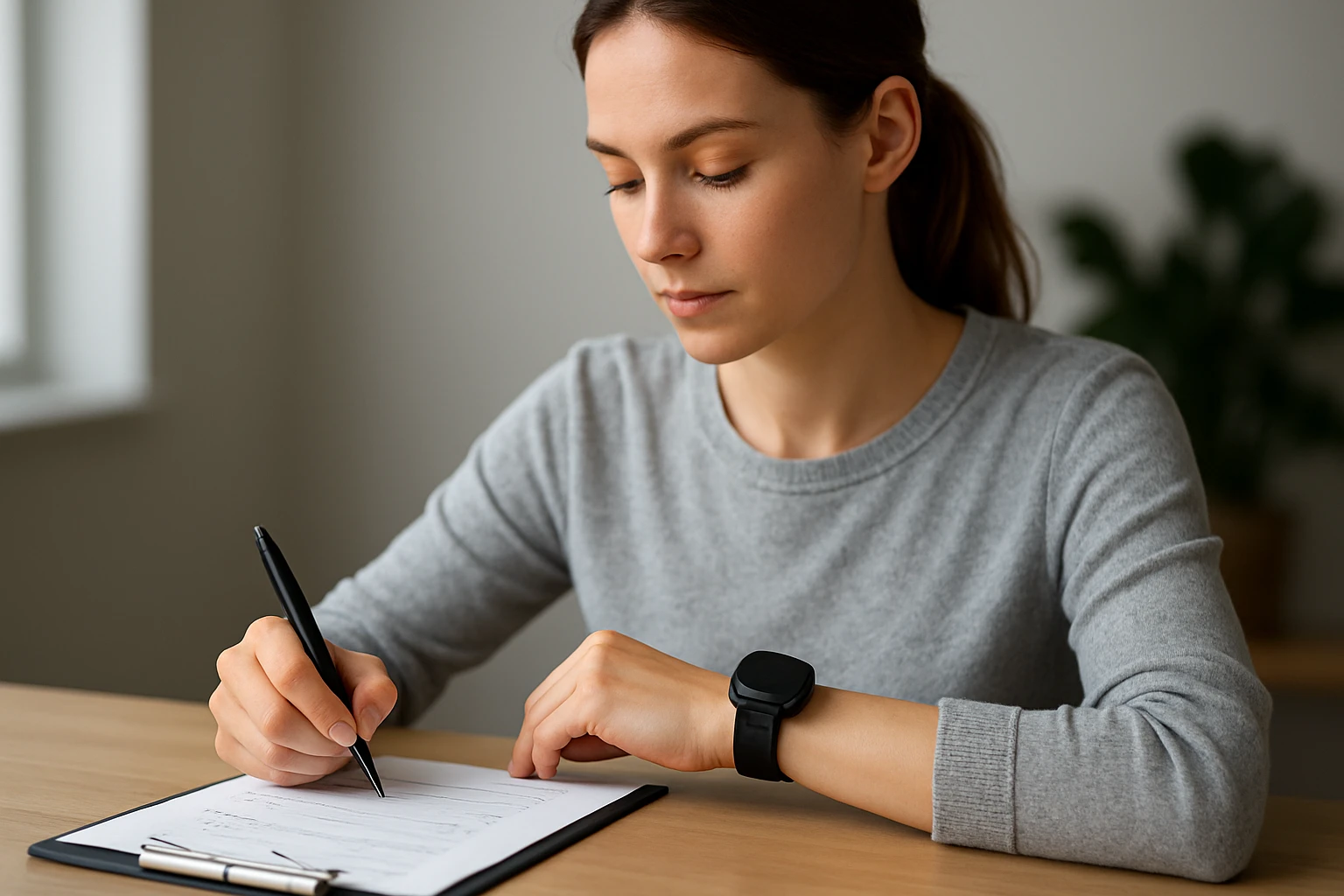
This is where people usually cheat without meaning to. One unexpectedly good night happens, and suddenly the experiment feels “proven.” Slow down. Compare your baseline notes with at least a week of sessions. A before-and-after log is one of the simplest self-tracking tools we have, and it works precisely because it asks you to look for repetition, not drama.
| Pattern | Probably A Signal | Probably Noise |
|---|---|---|
| Sleep onset | You fall asleep faster on several similar nights | One great night after an exhausting day |
| Stress rating | Your pre-bed 7/10 drops to 4/10 across multiple sessions | You felt calm once after canceling a stressful meeting |
| Pain flare-up | The same body area eases after repeated sessions | Pain vanished on a day you barely sat down |
I’ve had experiments where night one felt magical and nights two through six were flat. That doesn’t make night one fake. It just means night one wasn’t enough.
Look for changes in sleep onset, calm, and pain flare-ups
Track the areas that actually make sense. Harvard Health says stress can affect sleep, mood, and appetite, so those are reasonable places to watch for change over time. Sleep onset. Evening calm. Pain flare-ups. Appetite when stress runs high. Keep your eyes there.
And yes, Harvard Health also notes that chronic stress has been linked to cardiovascular disease, obesity, and Alzheimer’s disease. That should make you take stress seriously. It should not tempt you to inflate what one session means. Respect the stakes without making giant claims from tiny data.
Use a simple 1–10 rating to reduce wishful thinking
A plain 1–10 scale works because it forces you to pin a feeling to a number. Not perfectly. Just consistently. Define your anchors once and reuse them. For example, 1 might mean “fully settled,” 5 might mean “noticeably tense,” and 10 might mean “can’t settle, body buzzing.” Same scale every night. Same symptom. Same honesty.
- Score before the session.
- Score after the session.
- Score again the next morning if sleep or overnight pain is involved.
One calm evening is not evidence.
Common misses: Avoid the biggest interpretation errors
Don't confuse relaxation with diagnosis
Feeling calmer matters. Better sleep matters. Less pain matters. But those shifts do not diagnose the cause of your symptoms. This is where people slide from “I felt better after use” into “Now I know what’s wrong with me.” No, you don’t. You learned something narrower and still useful: a routine may be helping a symptom in a repeatable way.
- Keep your claims as small as your evidence.
- Say “this helped me feel calmer,” not “this explains my condition.”
- Bring persistent or worsening symptoms to a clinician.
Don't ignore sleep, food, and stress triggers
Stress is slippery. Harvard Health says defining it is tricky, and that’s exactly why you need to respect the obvious confounders. Sleep debt, skipped meals, alcohol, extra caffeine, a fight with your partner, a brutal workout, a medication change — any one of these can muddy your result. I once blamed a device for a terrible night when the real villain was embarrassingly simple: a 4 p.m. espresso and a late Liverpool match.
- Log unusual stressors the same day they happen.
- Notice changes in appetite and mood alongside sleep.
- Don’t pretend the device exists in a vacuum.
Don't keep going if symptoms worsen or stay unchanged
Search results already tell you this topic sits between science and marketing. On one page you’ll see Harvard Health asking hard questions. On another, you’ll see wellness and product pages making the practice sound smooth and obvious. That gap is exactly why stopping is sometimes the smartest move.
If your baseline doesn’t budge after an honest test, pause. If symptoms worsen, stop sooner. Reassess the timing, the environment, the target symptom, or whether this is even the right tool for you. A non-result still teaches you something. It saves you from months of hopeful guessing.
If the habit is not changing your baseline, stop and reassess.
Here’s the promise: if frequency-based wellness is going to matter, it should leave fingerprints in your notes.
That means one clear symptom, a steady routine, and enough days to spot a pattern in sleep, calm, appetite, or pain — not a single lucky night and a hopeful story.
If you’re still asking can frequency-based wellness help support better balance, what would your own seven-night test need to show before you’d believe it?
See What’s Possible With Anywhere Healing
Anywhere Healing offers biosensor-based wellness support, guided frequency sessions, and app-connected self-care experiences designed to help support sleep, calm, focus, and recovery in a non-invasive, drug-free way.
Explore Relief


